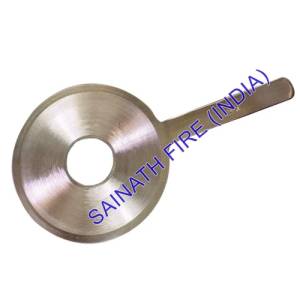
orifice plates

      Description


      Precision Orifice Plates for Reliable Flow Measurement & Control

      Overview

      Orifice plates are fundamental primary flow elements widely utilized across industries for accurate and cost-effective flow measurement of liquids, gases, and steam. As a critical component in differential pressure (DP) flowmeter systems, they create a measurable pressure drop proportional to the fluid's flow rate, enabling precise monitoring and control of processes.

      Our precision-engineered orifice plates offer robust construction, consistent performance, and adherence to international standards, making them an ideal choice for a vast range of industrial applications.

      Key Features & Benefits

      • High Accuracy & Repeatability: When properly installed and calibrated within a DP system, our orifice plates provide highly accurate and repeatable flow measurement data crucial for process optimization and billing.
      • Robust & Simple Design: With no moving parts, orifice plates are inherently durable, requiring minimal maintenance and offering a long operational lifespan even in demanding environments.
      • Cost-Effective Solution: They represent one of the most economical solutions for flow measurement, especially for larger line sizes and high-pressure applications.
      • Wide Application Versatility: Suitable for a broad spectrum of fluids, temperatures, and pressures, making them highly adaptable to various industrial processes.
      • Standard Compliance: Manufactured in strict accordance with international standards such as ISO 5167, AGA 3, and ASME, ensuring predictable performance and global interoperability.
      • Material Compatibility: Available in a diverse range of materials to suit corrosive, abrasive, high-temperature, or cryogenic applications.
      • Easy Installation & Replacement: Designed for straightforward installation between pipe flanges, facilitating quick setup and minimal downtime for maintenance or replacement.
      • Multiple Plate Configurations: Offered in various types to optimize performance for specific fluid characteristics and process conditions.

      Technical Specifications

      | Feature | Details Orifice Plate Types: Concentric (Square-Edged), Quadrant-Edged, Eccentric, Segmental, Restriction Orifice Plates (ROPs), Restriction Orifice Plate (ROP) assemblies.

      • Line Sizes: DN15 (1/2") to DN1000 (40") and larger upon request.
      • Materials: 316/316L SS (Standard), Duplex SS, Super Duplex SS, Monel, Hastelloy, Inconel, Carbon Steel (with/without coating), PVC, PTFE, Tantalum, Titanium, etc. (Other materials available upon request).
      • Pressure Ratings: ANSI Class 150 to 2500+ (PN10 to PN400+), exceeding class ratings with specific design.
      • Temperature Range: Cryogenic (-196°C) up to 800°C (1472°F) depending on material and sealing arrangements.
      • Accuracy: Typically ±0.5% to ±2% of full scale (when properly installed and paired with an appropriate DP transmitter).
      • Differential Pressure (DP) Taps: Flange taps, Corner taps, D-D/2 taps, Vena Contracta taps, Radius taps.
      • Bore Tolerances: Manufactured to precise tolerances as specified by relevant standards (e.g., ISO 5167).
      • Finish: Standard machined finish; specific Ra finish available for critical applications.
      • Marking: Each plate is permanently marked with essential data (material, line size, bore, standard, heat number, serial number).

      Orifice Plate Configurations

      1. Concentric (Square-Edged) Orifice Plate:
        • Description: The most common type, featuring a concentric bore with a sharp, square upstream edge.
        • Application: Ideal for clean liquids, gases, and low-velocity steam.
        • Benefits: Predictable performance, well-documented flow characteristics, and ease of manufacture.
      2. Quadrant-Edged Orifice Plate:
        • Description: Features a rounded, quarter-circle profile at the inlet bore.
        • Application: Best suited for viscous fluids (e.g., heavy oils, slurries) at low Reynolds numbers where square-edged plates can be inaccurate.
        • Benefits: Maintains accuracy at lower Reynolds numbers, reduces wear, and minimizes clogging.
      3. Eccentric Orifice Plate:
        • Description: Bore is offset from the center of the plate, tangent to either the top or bottom of the pipe.
        • Application: For fluids containing entrained solids, gas, or vapor where a concentric plate could cause buildup or blockages.
        • Benefits: Allows solids, liquids, or gases to pass through, preventing accumulation upstream of the plate, reducing maintenance.
      4. Segmental Orifice Plate:
        • Description: Bore is shaped like a segment of a circle.
        • Application: Similar to eccentric plates, used for fluids with high concentrations of entrained solids, slurries, or those that might stratify.
        • Benefits: Maximizes the open area to reduce clogging while still generating a differential pressure.
      5. Restriction Orifice Plate (ROP):
        • Description: Designed to create a permanent, non-measuring pressure drop in the line, primarily for flow restriction or pressure reduction. Often used for noise reduction or cavitation prevention downstream.
        • Application: Process lines requiring fixed flow restriction, pump protection, pressure let-down.
        • Benefits: Simple, effective, and maintenance-free for specific flow restriction tasks.

      Applications

      • Oil & Gas: Production, refining, custody transfer, flare gas measurement.
      • Chemical & Petrochemical: Reaction control, mass balance, utility flow (steam, cooling water).
      • Power Generation: Boiler feed water, steam, fuel gas measurement.
      • Water & Wastewater: Intake and discharge monitoring, chemical dosing control.
      • HVAC: Airflow measurement in large ducting systems.
      • Food & Beverage: Utility flow, process ingredient flow (non-abrasive).
      • Pharmaceutical: Utility flow, non-critical process fluid measurement.
      • Industrial Utilities: Compressed air, natural gas, nitrogen, oxygen lines.

      Compliance & Standards

      • ISO 5167: Measurement of fluid flow by means of pressure differential devices inserted in circular cross-section conduits running full.
      • AGA 3: Orifice Metering of Natural Gas and Other Related Hydrocarbon Fluids.
      • ASME: Relevant sections for pressure vessel codes and material specifications.
      • NACE MR0175 / ISO 15156: For materials in sour service applications (upon request).
      • PED 2014/68/EU: For pressure accessories (upon request).

      Customization & Support

      We understand that every application is unique. We offer comprehensive customization options including:

      • Material Selection: Any specified alloy or non-metallic material.
      • Bore Sizing & Calculations: Precision sizing based on your specific process parameters, engineered to meet desired DP and flow rate.
      • Mounting Configurations: Tailored for specific flange types (e.g., RTJ, Raised Face, Flat Face) and tap arrangements.
      • Orifice Plate Assemblies: Supply with matching orifice flanges, meter runs, and seal rings for a complete solution.
      • Certification & Documentation: Material test reports (MTRs), conformance certificates, and NDT reports available.
      • Technical Consultation: Our experienced engineering team is available to assist with selection, sizing, and application challenges.

      Tags: orifice plates