Description
Here's a detailed product description for "Mechanical Foam Type" in Markdown format, covering various aspects of its function, types, and applications.
Advanced Mechanical Foam Fire Suppression Systems & Concentrates
In environments where flammable liquids, combustible solids, and critical assets are at risk, a robust and reliable fire suppression strategy is paramount. Mechanical Foam Type Fire Suppression Systems stand as an essential defense, designed to rapidly control, extinguish, and prevent re-ignition of a wide range of fires, particularly those involving hydrocarbons and polar solvents.
Unlike chemical foams, mechanical foams are generated by the physical mixing of water, a specialized foam concentrate, and air, using proportioning and discharge equipment. This creates a stable, cohesive foam blanket that effectively smothers fires and protects valuable assets.
Key Features & Advantages:
- Versatile Fire Suppression: Highly effective against Class A (ordinary combustibles) and Class B (flammable liquids and gases) fires, including hydrocarbons (oil, gasoline) and polar solvents (alcohols, ketones, esters).
- Rapid Knockdown: Forms a fast-acting aqueous film or foam blanket to quickly suppress flames and prevent flashover.
- Superior Blanketing & Sealing: Creates a stable, durable foam layer that effectively smothers the fire by separating the fuel from oxygen. It also seals the fuel surface, preventing the release of flammable vapors.
- Excellent Cooling Properties: The water content in the foam absorbs heat, cooling the fuel and surrounding surfaces to prevent re-ignition.
- Re-ignition Prevention: The insulating and vapor-sealing properties of the foam significantly reduce the risk of fire re-ignition, even after initial suppression.
- Fuel Shedding Capabilities: Certain foam types (e.g., FFFP) excel at shedding burning fuel from the foam blanket, maintaining integrity.
- Environmental Responsibility: A wide range of environmentally responsible C6 fluorotelomer-based and fluorine-free (F3) foam concentrates are available, complying with the latest global environmental regulations (e.g., EU PFOA/PFOS directives).
- Long-Term Concentrate Stability: High-quality foam concentrates offer extended shelf life, ensuring readiness when needed.
How Mechanical Foam Works:
Mechanical foam is generated through a three-step process:
- Proportioning: A precise amount of foam concentrate is mixed with water using a proportioner (e.g., venturi, bladder tank, balanced pressure pump) to create a foam solution (e.g., 1%, 3%, 6% solution).
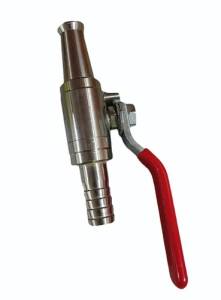
- Aeration: The foam solution then passes through a specialized discharge device (e.g., foam nozzle, foam chamber, sprinkler, monitor) which introduces air into the solution.
- Foaming: The introduction of air generates millions of small, air-filled bubbles, forming a stable foam blanket that spreads over the burning surface.
The foam extinguishes fire primarily through:
- Smothering: Separating oxygen from the fuel.
- Cooling: Water in the foam absorbs heat.
- Vapor Suppression: Creating a barrier that prevents flammable vapors from escaping the fuel surface and mixing with air.
- Fuel/Air Separation: For film-forming foams (AFFF, FFFP), an aqueous film spreads rapidly over the fuel surface beneath the foam blanket, providing additional vapor suppression.
Types of Mechanical Foam Concentrates:
The choice of foam concentrate is critical and depends on the specific fire risk. Our range includes:
- Aqueous Film-Forming Foam (AFFF):
- Description: Contains fluorochemical surfactants that create a thin, aqueous film over hydrocarbon fuels, providing rapid knockdown and vapor suppression in addition to the foam blanket.
- Applications: Ideal for Class B hydrocarbon fires (e.g., gasoline, diesel, crude oil).
- Versions: Available in 1%, 3%, and 6% concentrations, including C6 compliant and fluorine-free (F3) options.
- Film-Forming Fluoroprotein Foam (FFFP):
- Description: Combines the quick knockdown of AFFF with the tough, durable blanket and fuel-shedding properties of protein foams.
- Applications: Excellent for large-scale hydrocarbon fires, especially where strong heat resistance and re-ignition prevention are crucial.
- Versions: Typically 3% or 6%.
- Alcohol-Resistant AFFF (AR-AFFF):
- Description: Formulated with a polymeric additive that forms a protective membrane over polar solvents (water-miscible fuels) when diluted. This prevents the foam from being broken down by the fuel.
- Applications: Essential for fires involving polar solvents (e.g., ethanol, methanol, IPA, acetone) and also effective on hydrocarbons.
- Versions: Available in 3%x3%, 3%x6%, and 1%x3% concentrations for dual-purpose use.
- Protein Foam:
- Description: One of the oldest foam types, derived from hydrolyzed protein. Produces a tough, durable, and highly heat-resistant foam blanket.
- Applications: Primarily for Class B hydrocarbon fires, especially suitable for deep-seated fires and long pre-burn conditions. Less flowable than AFFF.
- Fluoroprotein Foam (FP):
- Description: Protein foam with added fluorochemical surfactants for improved flow, fuel shedding, and extended storage life compared to basic protein foam.
- Applications: Similar to protein foam but with enhanced performance characteristics.
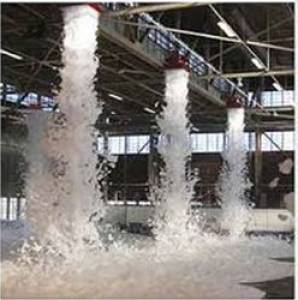
- High-Expansion Foam:
- Description: Produces very large volumes of lightweight foam (expansion ratios 200:1 to 1000:1) with minimal water content.
- Applications: Ideal for filling large, enclosed spaces (e.g., hangars, warehouses, mines, cable tunnels) to smother fires where water damage must be minimized.
- Fluorine-Free Foam (F3 / FFFP-F):
- Description: Advanced foam technology developed without any fluorosurfactants, addressing environmental concerns associated with traditional AFFF/FFFP. Uses alternative proprietary surfactants to create a robust foam.
- Applications: Suitable for a range of Class B hydrocarbon fires, with some AR-F3 variants available for polar solvents. Gaining widespread adoption due to environmental regulations.
Typical Applications & Industries:
- Petrochemical & Oil & Gas Facilities: Refineries, storage tanks (floating roof and fixed roof), loading racks, pipelines, processing plants.
- Aviation: Aircraft hangars, fuel farms, airport runways (crash tenders).
- Marine & Offshore: Ships (cargo, passenger, naval), offshore oil platforms, heliports.
- Chemical Manufacturing Plants: Facilities handling flammable liquids and polar solvents.
- Power Generation: Turbine enclosures, fuel storage areas.
- Warehousing & Logistics: Storage of flammable liquids, aerosols, and other hazardous materials.
- Industrial Facilities: Factories, processing areas with potential Class B fire risks.
- Mining: Confined spaces for high-expansion foam applications.
Technical Specifications (Vary by Product & Type):
- Concentration Ratios: 1%, 3%, 6%
- Expansion Ratios: Low, Medium, High
- Fire Rating: UL, FM, EN, IMO (SOLAS), ICAO, LASTFIRE, NFPA compliant
- Viscosity: (mPa.s)
- Pour Point / Freeze Point: (Temperature Range)
- Storage Temperature Range: (e.g., -10°C to +50°C)
- Shelf Life: 10-25 years (depending on concentrate type and storage conditions)
- Specific Gravity: (kg/m³)
- pH: (at 20°C)
- Surface Tension: (mN/m)
Why Choose Our Mechanical Foam Solutions?
We are committed to providing cutting-edge mechanical foam fire suppression solutions that deliver unmatched performance and peace of mind. Our products are:
- Proven & Certified: Extensively tested and certified by leading international approval bodies.
- Reliable: Engineered for consistent performance under the most demanding conditions.
- Environmentally Conscious: Offering a comprehensive portfolio of C6 and fluorine-free (F3) foam concentrates to meet evolving regulatory and ecological standards.
- Expert-Backed: Supported by a team of fire protection specialists ready to assist with system design, concentrate selection, and technical support.
- Customizable: Solutions tailored to the unique risks and requirements of your facility.