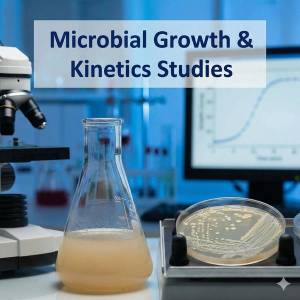
Microbial Growth & Kinetics Studies

      Description


      Microbial Growth & Kinetics Studies

      Unlock the Secrets of Microbial Dynamics for Advanced Research and Industrial Applications

      Microbes are the unseen architects and engineers of our world, driving processes from nutrient cycling and bioremediation to industrial fermentation and disease. Understanding how they grow, at what rate, and under what conditions is fundamental to leveraging their potential and mitigating their challenges.

      Our comprehensive solution for Microbial Growth & Kinetics Studies is designed to equip researchers, students, and industry professionals with the theoretical knowledge and practical tools to accurately characterize, model, and predict microbial behavior. Dive deep into the quantitative aspects of microbiology and gain unparalleled insights that drive innovation.

      Why Microbial Growth & Kinetics Matter:

      • Optimization: Maximize product yield in bioreactors, optimize wastewater treatment, enhance biofuel production.
      • Prediction: Forecast food spoilage, estimate shelf-life, predict pathogen spread, model ecosystem responses.
      • Discovery: Accelerate antimicrobial drug development, identify novel biocatalysts, understand host-pathogen interactions.
      • Control: Design effective sterilization protocols, manage microbial contamination, develop robust preservation strategies.

      Key Features & Benefits:

      • Master Fundamental Principles:
        • Delve into the distinct phases of microbial growth – lag, exponential, stationary, and death – and understand the underlying physiological changes.
        • Grasp key parameters: specific growth rate (μ), doubling time (td), biomass yield (Y), and saturation constant (Ks).
        • Explore factors influencing growth: temperature, pH, aeration, osmolarity, and nutrient availability.
      • Advanced Kinetic Modeling:
        • Monod Kinetics: Understand the cornerstone model for substrate-limited growth.
        • Non-Monod Models: Explore more complex kinetics, including substrate inhibition, product inhibition, and unstructured models.
        • Mathematical Tools: Learn to apply differential equations, curve fitting, and statistical analysis for robust model development and validation.
      • Experimental Design & Execution:
        • Batch Culture: Design and analyze growth curves in closed systems.
        • Continuous Culture: Master the principles and operation of chemostats and turbidostats for steady-state analysis and physiological studies.
        • Data Acquisition: Techniques for measuring biomass (OD, dry weight, cell counting), substrate consumption, and product formation.
        • Reproducibility & Accuracy: Best practices for experimental setup, sampling, and quality control.
      • Environmental & Nutritional Influences:
        • Investigate the impact of various carbon, nitrogen, and energy sources on growth kinetics.
        • Understand the role of micronutrients, trace elements, and vitamins.
        • Analyze the effects of inhibitory compounds and stress conditions.
      • Data Analysis & Interpretation:
        • Utilize specialized software and analytical methods for fitting kinetic models to experimental data.
        • Perform sensitivity analysis and parameter estimation.
        • Translate quantitative data into actionable insights for research and industrial applications.
      • Troubleshooting & Optimization Strategies:
        • Identify common pitfalls in experimental design and data interpretation.
        • Develop strategies for optimizing culture conditions for desired outcomes (e.g., maximum growth rate, highest yield, specific metabolite production).

      Who Will Benefit:

      • Microbiologists & Biotechnologists: Deepen your understanding of microbial physiology and apply advanced modeling techniques.
      • Chemical & Process Engineers: Optimize bioreactor design, scale-up, and operation for industrial processes.
      • Food Scientists: Predict spoilage, design preservation methods, and ensure food safety.
      • Environmental Scientists: Model bioremediation processes, understand ecological dynamics, and manage microbial communities.
      • Pharmaceutical Researchers: Develop novel antimicrobials, optimize fermentation for drug production, and study pathogenesis.
      • Academic Researchers & Students: Enhance your research capabilities, master essential analytical skills, and design impactful experiments.

      What's Included (Conceptual Package – actual components may vary based on offering):

      • Comprehensive Theoretical Modules: In-depth coverage of all kinetic models and principles.
      • Detailed Experimental Protocols: Step-by-step guides for batch and continuous culture setups.
      • Data Analysis Templates & Software Recommendations: Tools for efficient data processing, curve fitting, and statistical analysis (e.g., Excel templates, R/Python scripts, specialized software guides).
      • Real-World Case Studies: Examples demonstrating the application of kinetics in various industries.
      • Troubleshooting Guides: Solutions to common experimental and analytical challenges.
      • Glossary of Terms: A comprehensive resource for key microbial kinetics terminology.

      Take the Next Step in Quantitative Microbiology!

      Empower your research and development with a robust understanding of microbial growth and kinetics. Move beyond qualitative observations to precise, predictive insights.

      Contact us today to explore our tailored solutions, training programs, and consulting services in Microbial Growth & Kinetics Studies.

      Tags: Microbial Growth & Kinetics Studies