Description
CO2 Flooding System: Rapid, Residue-Free Fire Suppression for Critical Assets
When fire threatens high-value assets, sensitive equipment, or critical infrastructure, conventional water or foam suppression can cause as much damage as the fire itself. Our advanced CO2 Flooding System offers a robust, swift, and residue-free solution designed to extinguish fires quickly without collateral damage, ensuring operational continuity and protecting your investments.
What is a CO2 Flooding System?
A CO2 (Carbon Dioxide) Flooding System is a fixed fire suppression system that uses liquefied carbon dioxide stored under pressure. Upon activation, CO2 is rapidly discharged into an enclosed space, displacing oxygen and effectively smothering the fire. As a clean agent, CO2 leaves no residue, eliminating the need for costly and time-consuming cleanup after discharge.
Key Features & Benefits:
- Rapid Fire Extinguishment: CO2 quickly reduces oxygen levels to below the combustion threshold, suffocating fires almost instantaneously, minimizing damage and downtime.
- Residue-Free Protection: Leaves no water, foam, or chemical residue, making it ideal for protecting sensitive electronics, data, archives, and machinery. No post-fire cleanup required.
- Non-Conductive & Non-Corrosive: Electrically non-conductive and non-corrosive, making it perfectly safe for use in areas with live electrical equipment and delicate components.
- Effective on Diverse Fire Classes: Highly effective on Class A (ordinary combustibles), Class B (flammable liquids and gases), and Class C (energized electrical equipment) fires.
- Economical: Low initial cost compared to some other clean agents, and zero cleanup costs contribute to a lower total cost of ownership.
- Proven Technology: CO2 fire suppression has been a reliable and trusted method for decades, meeting stringent safety and performance standards.
- Flexible System Design: Available in both high-pressure and low-pressure storage options, allowing for customization based on the protected area's size and specific requirements.
How It Works:
Upon detection of a fire by integrated smoke or heat detectors, the system's control panel initiates a pre-discharge alarm sequence, allowing personnel to safely evacuate. After a timed delay, the CO2 agent is released through a network of piping and discharge nozzles, rapidly filling the protected space. The CO2 quickly reduces the oxygen concentration below the level required for combustion, extinguishing the fire without causing damage to assets.
Ideal Applications:
Our CO2 Flooding Systems are the ideal choice for environments where fire damage or residue from other extinguishing agents would be unacceptable:
- Data Centers, Server Rooms & Telecom Facilities: Protecting critical IT infrastructure.
- Electrical Control Rooms & Switchgear: Safeguarding vital electrical distribution systems.
- Generator Enclosures & Turbine Hoods: Suppressing fires in power generation equipment.
- Industrial Processes & Machinery: Protecting manufacturing lines, robotics, and hydraulic systems.
- Flammable Liquid Storage Areas: Containing and extinguishing fires involving volatile fuels.
- Marine Vessels & Engine Rooms: Essential fire protection for shipboard operations.
- Archive & Museum Facilities: Preserving invaluable documents, artifacts, and historical items.
- Paint Booths & Coating Operations: Managing risks associated with flammable solvents.
Crucial Safety Considerations:
IMPORTANT: CO2 is an asphyxiant and extremely hazardous to humans in concentrations high enough to extinguish a fire. Our systems are designed with the highest safety standards to mitigate this risk, including:
- Audible & Visual Pre-Discharge Alarms: To ensure all personnel evacuate the protected area before CO2 release.
- Emergency Abort Switches: To allow manual cancellation of discharge during the pre-discharge delay.
- Lock-Out/Tag-Out Systems: To prevent accidental discharge during maintenance.
- Warning Signage: Clearly indicating the presence of a CO2 system and its associated dangers.
- Ventilation Protocols: To safely remove CO2 from the protected space after discharge.
Our expert team provides thorough training and ensures strict adherence to all safety protocols and regulatory requirements (e.g., NFPA 12) for system design, installation, and operation.
System Components:
A typical CO2 Flooding System includes:
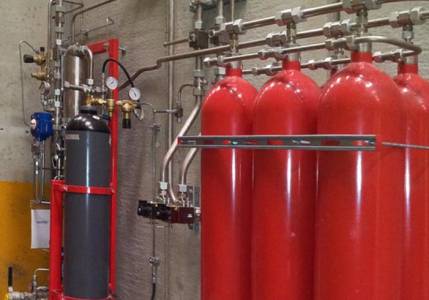
- CO2 Storage Cylinders: High-pressure cylinders (e.g., 50lb, 75lb, 100lb) or low-pressure refrigerated tanks for larger volumes.
- Selector Valves & Manifolds: To direct CO2 to specific hazard areas.
- Discharge Nozzles: Strategically placed for uniform CO2 distribution.
- Piping Network: Seamless steel piping to transport CO2 from storage to nozzles.
- Fire Detection System: Smoke, heat, or flame detectors interfaced with the control panel.
- Control Panel: The intelligent hub for system monitoring, activation, and alarm management.
- Audible & Visual Alarms: Horns, strobes, and warning lights.
- Manual Release Stations: For human-initiated discharge in emergencies.
- Pressure Switches & Supervisory Devices: For system integrity monitoring.
Compliance & Certifications:
Our CO2 Flooding Systems are designed, installed, and maintained in strict accordance with:
- NFPA 12: Standard on Carbon Dioxide Extinguishing Systems.
- UL, FM Global, and other relevant local/international fire codes and standards.
- ISO 9001 quality standards.