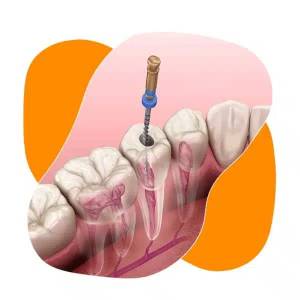

# Root Canal Treatment (Endodontic Therapy) ## Save Your Natural Tooth, Relieve Your Pain, Restore Your Oral Health. **Overview:** Root Canal Treatment, also known as endodontic therapy, is a highly effective dental procedure designed to save a tooth that has become severely infected or inflamed. When the soft inner tissue of your tooth (the pulp), containing nerves and blood vessels, becomes compromised due to deep decay, repeated dental procedures, cracks, or trauma, it can lead to excruciating pain and risk the loss of the tooth. RCT meticulously removes the infected pulp, cleans and shapes the inside of the root canal, and then fills and seals the space, preserving your natural tooth and preventing further complications. --- ### Why is Root Canal Treatment Necessary? Your teeth are designed to last a lifetime, but sometimes the pulp inside a tooth can become infected or inflamed. This often happens when bacteria from deep decay or a crack in the tooth reaches the pulp chamber. If left untreated, this infection can cause: * **Severe, persistent toothache:** Especially when chewing or applying pressure. * **Sensitivity to hot and cold:** Lingering pain after exposure to temperature. * **Swelling and tenderness:** In the gums surrounding the affected tooth. * **Pimple-like bump on the gums:** A sign of an abscess. * **Tooth discoloration:** The tooth may darken. * **Pain that wakes you up at night.** --- ### The Benefits of Choosing RCT: Opting for a root canal treatment offers numerous advantages over tooth extraction, providing a long-term solution for your oral health: * **Pain Relief:** Eliminates the source of infection and inflammation, effectively relieving toothache. * **Preserves Your Natural Tooth:** Saves your tooth from extraction, allowing you to keep your natural smile and bite. * **Maintains Chewing Efficiency:** A preserved tooth functions just like any other tooth, allowing for normal chewing. * **Protects Adjacent Teeth:** Prevents shifting of neighboring teeth that can occur after an extraction. * **Aesthetic Benefits:** With a final restoration (often a crown), the treated tooth can look and function like a natural tooth. * **Cost-Effective in the Long Run:** Often more affordable than replacing an extracted tooth with an implant or bridge. * **Prevents Further Infection:** Stops the spread of infection to other teeth, gums, and potentially other parts of your body. --- ### The Root Canal Procedure: What to Expect Modern root canal treatments are highly advanced and typically completed in one or two appointments, depending on the severity of the infection and complexity of the tooth. 1. **Diagnosis and Anesthesia:** We begin with a thorough examination, including X-rays, to assess the extent of the infection. Local anesthesia is administered to numb the tooth and surrounding area, ensuring a comfortable and pain-free experience during the procedure. 2. **Isolation:** A rubber dam (a small sheet of latex or non-latex material) is placed around the tooth to isolate it, keeping it clean and free from saliva during the treatment. 3. **Access Cavity:** A small opening is made on the chewing surface of back teeth or the lingual side of front teeth to access the pulp chamber and root canals. 4. **Cleaning and Shaping:** Using specialized tiny instruments, the infected and inflamed pulp is carefully removed from the pulp chamber and root canals. The canals are then meticulously cleaned, disinfected, and shaped to prepare them for filling. 5. **Irrigation:** The canals are flushed with an antimicrobial solution to thoroughly cleanse them and eliminate bacteria. 6. **Filling (Obturation):** Once clean and shaped, the canals are filled with a biocompatible, rubber-like material called gutta-percha, usually combined with a sealer. This fills the entire canal system, preventing reinfection. 7. **Temporary Filling:** A temporary filling is placed in the access cavity to seal the tooth until your next appointment for the final restoration. 8. **Final Restoration:** In most cases, a crown is recommended after a root canal to protect the treated tooth from fracture and restore its full function and appearance. This final restoration is crucial for the long-term success of the treatment. --- ### After Your Root Canal Treatment: * **Temporary Sensitivity:** It's normal to experience some mild sensitivity or soreness for a few days after the procedure, especially when chewing. This can usually be managed with over-the-counter pain relievers. * **Final Restoration:** It is vital to return for your final restoration (e.g., a crown) as recommended. This provides the necessary protection for the treated tooth, which can become brittle over time. Delaying or skipping this step significantly increases the risk of tooth fracture and treatment failure. * **Oral Hygiene:** Continue with your regular brushing, flossing, and routine dental check-ups to maintain overall oral health. --- ### Potential Risks and Considerations: While root canal treatment has a high success rate (over 95%), as with any medical procedure, there are minimal risks: * **Re-infection:** Though rare, a treated tooth can become re-infected if the initial cleaning was not complete, a new cavity forms, or the final restoration is delayed or insufficient. * **Tooth Fracture:** A non-vital tooth can become more brittle and prone to fracture, which is why a crown is strongly recommended. * **Need for Re-treatment:** In some cases, if symptoms persist or re-appear, a re-treatment may be necessary. --- ### Frequently Asked Questions (FAQ): **Q: Is a root canal painful?** A: Modern root canal treatments are typically performed under local anesthesia, making the procedure itself as comfortable as having a routine filling. The goal is to relieve pain, not cause it. You might experience some mild discomfort or soreness after the procedure, which can be managed with over-the-counter pain medication. **Q: How long does a root canal-treated tooth last?** A: With proper care, good oral hygiene, and a timely final restoration (usually a crown), a root canal-treated tooth can last a lifetime. **Q: Is extraction a better option?** A: Generally, no. Saving your natural tooth is almost always the best option. An extracted tooth requires replacement (with an implant or bridge), which can be more expensive, more invasive, and may lead to other dental problems over time. **Q: Will I need a crown after my root canal?** A: In most cases, yes, especially for back teeth that bear significant chewing forces. A crown protects the treated tooth from fracture, which can become more brittle after the pulp is removed. --- ## Don't Let Tooth Pain Control Your Life. If you are experiencing symptoms of a severe tooth infection or have been advised to undergo root canal treatment, don't delay. Early intervention can prevent further complications and save your natural tooth. **Contact Us Today for a Consultation:** [Your Clinic Name/Phone Number/Website] Our experienced team is here to provide gentle, effective care and answer all your questions. --- **Disclaimer:** This product description provides general information about Root Canal Treatment and should not be considered as medical advice. Individual results may vary. It is essential to consult with a qualified dental professional for a personalized diagnosis and treatment plan.