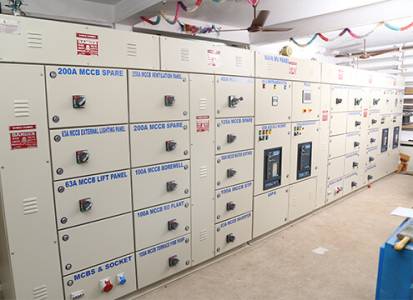
Main Medium Voltage (MV) Panel: Unrivaled Power Distribution & Protection
Product Overview
The Main Medium Voltage (MV) Panel is the critical cornerstone of any robust electrical infrastructure, serving as the primary interface between the utility supply or a large generation source and the facility's internal medium voltage distribution network. Designed for superior reliability, safety, and efficiency, our MV Panels are engineered to handle high power demands, provide comprehensive circuit protection, and facilitate intelligent power management in demanding industrial, commercial, and utility environments.
Whether you're managing a sprawling industrial plant, a high-rise commercial complex, a data center, or a utility substation, our Main MV Panels ensure the stable, secure, and controlled distribution of power, safeguarding your assets and maintaining operational continuity.
Key Features
1. Robust & Certified Enclosure
Heavy-Duty Steel Construction: Built to withstand harsh operating conditions and provide maximum physical protection.
High IP/NEMA Rating: Ensures protection against dust, moisture, and environmental ingress (e.g., IP41, IP54, NEMA 1, 3R, 12).
Modular Design: Allows for flexible configurations, future expansion, and ease of installation.
Arc-Resistant Design (Optional/Standard): Engineered to contain and redirect arc flash energy away from personnel, significantly enhancing safety (e.g., per IEC 62271-200 or ANSI C37.20.7 standards).
2. Advanced Circuit Breakers
Vacuum or SF6 Circuit Breakers: High-performance interrupting devices for reliable fault clearing and frequent switching operations.
High Interrupting Capacity: Designed to safely clear fault currents up to specified kA levels (e.g., 25kA, 31.5kA, 40kA).
Draw-out or Fixed Type: Offers flexibility for maintenance and operational preferences.
Long Mechanical & Electrical Life: Minimizes maintenance and ensures sustained performance.
3. High-Capacity Busbar System
Copper or Aluminum Busbars: Precisely engineered for high current carrying capacity and minimal power losses.
Robust Bracing: Designed to withstand high short-circuit forces.
Insulated & Segregated Compartments: Enhances safety and prevents fault propagation.
Communication Capabilities: Supports standard protocols like Modbus, DNP3, IEC 61850 for seamless integration with SCADA, DCS, and energy management systems.
Integrated Control Logic: Provides local and remote control capabilities for breakers and switches.
5. Integrated Metering & Monitoring
Multi-Function Meters: Real-time measurement of voltage, current, power (active/reactive), energy, power factor, and frequency.
Power Quality Monitoring: Detects harmonics, sags, swells, and transients to ensure grid stability and compliance.
Event Logging & Fault Records: Stores critical operational data for analysis and troubleshooting.
6. Enhanced Safety Features
Mechanical & Electrical Interlocks: Prevents unsafe operations, such as switching under load or accessing live parts.
Visible Disconnect & Grounding Switches: Provides clear indication of isolation and ensures personnel safety during maintenance.
Pressure Relief Vents: For arc-resistant designs, to safely vent hot gases in case of an internal arc.
Personnel Safety Barriers: To prevent accidental contact with live components.
7. Accessibility & Maintenance
Front or Front/Rear Access: Designed for ease of installation, inspection, and maintenance.
Removable Panels & Doors: Facilitates quick access to internal components.
Test Positions: For easy verification of protection schemes without de-energizing the main bus.
Key Benefits
Uncompromised Safety: Advanced arc-resistant design, interlocking mechanisms, and robust construction prioritize personnel safety and minimize risk during operation and maintenance.
Exceptional Reliability & Uptime: Built with high-quality components and rigorous testing to ensure continuous, stable power supply, reducing costly downtime.
Optimized Operational Efficiency: Integrated monitoring, precise control, and communication features enable smart grid integration, predictive maintenance, and efficient energy management.
Scalability & Future-Proofing: Modular design allows for easy expansion and adaptation to evolving power demands and technological advancements.
Regulatory Compliance: Designed and manufactured to meet stringent international standards (e.g., IEC, ANSI, UL), ensuring global applicability and peace of mind.
Reduced Maintenance: Durable components, easy access, and intelligent diagnostics contribute to lower maintenance requirements and extended operational life.
Cost-Effectiveness: Maximizes asset protection, reduces potential for costly outages, and optimizes energy consumption over the panel's lifespan.
Typical Applications
Industrial Facilities: Heavy manufacturing plants, chemical processing, steel mills, mining operations, oil & gas facilities.
Commercial & Institutional Buildings: Large office complexes, data centers, hospitals, universities, airports.
Utility Substations: Grid interconnection, distribution substations, renewable energy integration (solar farms, wind farms).
Infrastructure Projects: Transportation hubs, water treatment plants, power generation plants.
Marine & Offshore: Platforms, large vessels, port facilities (with specialized environmental considerations).