Posted By : Admin on 05-08-2026
A flat metal plate can become the foundation of a tank, machine component, structural assembly, ducting system, or specialized industrial part after the right forming process. In modern fabrication, achieving the required shape is not simply about applying force to metal. It involves understanding the material, thickness, dimensions, radius, angle, and final purpose of the component.
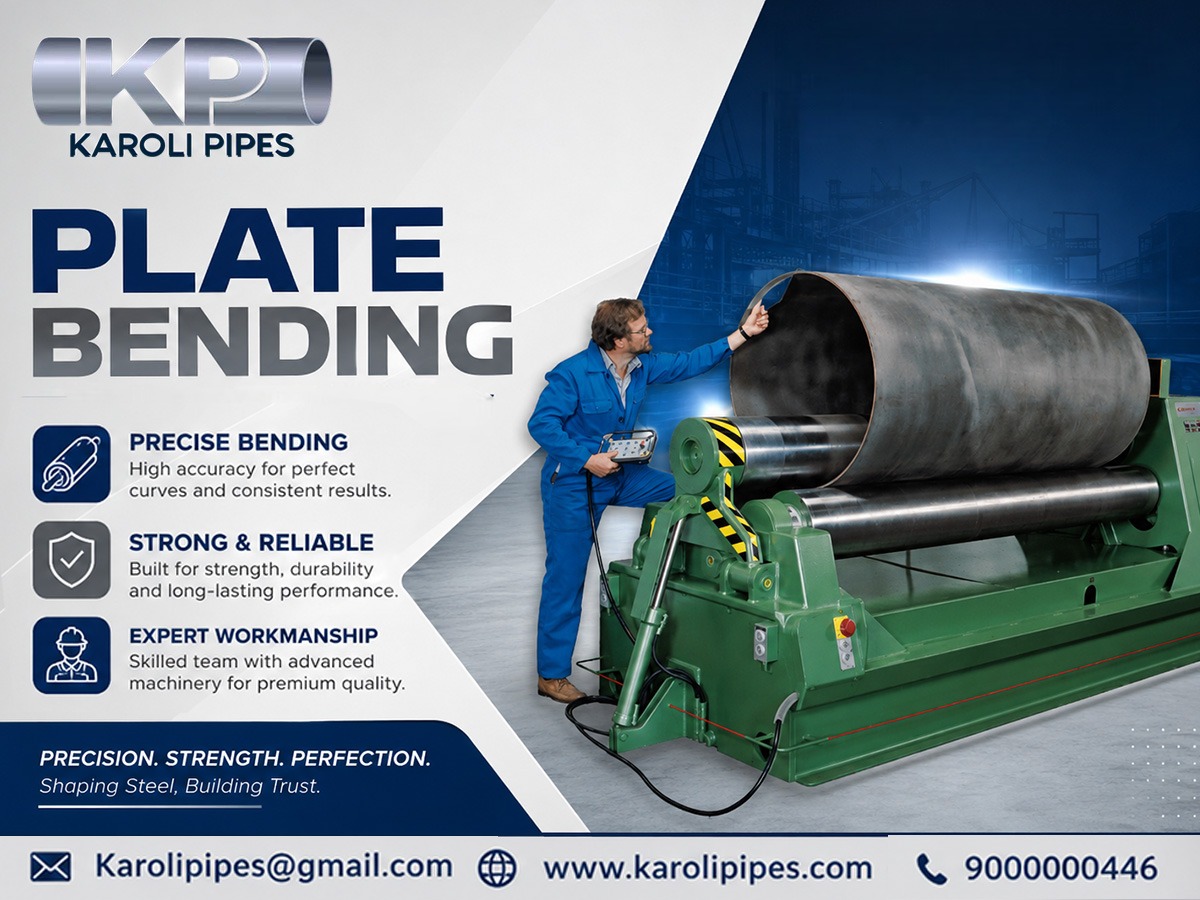
For companies requiring Plate Bending Services in Hyderabad, selecting a suitable fabrication partner can make a significant difference in achieving consistent and application-specific results. Karoli Pipes provides metal forming solutions for industrial, engineering, construction, manufacturing, and customized fabrication requirements.
Plate bending is a controlled metal-forming process in which flat plates are shaped into required profiles. Depending on the design, the finished plate may have an angle, curve, arc, cylindrical form, or customized geometry.
The process begins with understanding what the finished component needs to look like and how it will be used. Material grade, thickness, dimensions, bend angle, radius, and fabrication drawings all influence the process.
Unlike cutting, bending changes the geometry of the plate while keeping the material largely intact. This makes accurate process planning particularly important when the formed component needs to connect with other parts.
In industrial fabrication, even a small dimensional difference can create problems during assembly. A component that does not match its intended dimensions may require additional correction, welding adjustments, grinding, or even remanufacturing.
Professional metal forming helps businesses work toward consistent results by using suitable equipment and process parameters. The objective is to produce a component that meets the required specifications and fits properly into the larger assembly.
Accuracy is particularly important for projects involving multiple components because each part must work together as intended.
Not every metal behaves in exactly the same way during forming. Material strength, flexibility, thickness, and grade can influence the amount of force required and the final result.
Steel is widely used across construction and industrial fabrication. Businesses requiring Steel Plate Bending Services in Hyderabad may need different forming approaches depending on the steel grade and plate thickness.
Mild steel is another commonly processed material. It is used for structural components, industrial equipment, frames, supports, machinery, and customized fabrication. Mild Steel Plate Bending Services in Hyderabad can be considered when flat MS plates need to be transformed into specific profiles.
Stainless steel requires additional attention to grade, surface condition, forming behavior, and application requirements. Stainless Steel Plate Bending Services in Hyderabad can support projects where stainless steel components are required for industrial, commercial, engineering, or specialized applications.
Large industrial projects often involve plates that are considerably heavier and thicker than those used for light fabrication. These materials require suitable machinery, adequate forming capacity, and careful planning.
Heavy Plate Bending Services in Hyderabad can be useful for projects where large or thick plates need to be shaped into particular profiles. Before starting the work, the fabricator should consider the material grade, thickness, dimensions, radius, and required final geometry.
Heavy plate forming may be required in industrial machinery, structural fabrication, infrastructure, equipment manufacturing, storage systems, and other heavy engineering applications.
Not every project requires an angular bend. Many industrial components require smooth curves or cylindrical forms.
Plate rolling is generally used when a flat plate needs to be transformed into a continuous curved or cylindrical shape. This can be useful in the fabrication of tanks, shells, ducts, cylindrical structures, and other industrial components.
Companies searching for Plate Rolling Services in Hyderabad should provide clear technical specifications, including plate thickness, material, width, length, required diameter, and rolling radius. These details help determine the appropriate forming requirements.
Rolling and bending may sometimes be used together as part of a broader fabrication process, depending on the component design.
The versatility of plate forming makes it relevant to many industries. A single fabrication workshop may receive projects involving completely different shapes and materials.
Common applications include:
The exact process depends on the component's intended function and technical specifications.
Standard fabrication dimensions may not always meet the needs of specialized industrial projects. Engineers may specify unique angles, unusual radii, complex curves, or specific component dimensions.
This is where Custom Plate Bending Services in Hyderabad can be useful. Customized forming allows the fabrication process to be planned around the actual engineering requirements of the component.
A detailed drawing can communicate essential information such as plate dimensions, material grade, thickness, bend locations, radius, angles, and finished dimensions. Clear specifications help reduce uncertainty before fabrication begins.
Several factors influence the outcome of plate forming.
A thicker plate generally requires more forming force and suitable equipment capacity.
The required inside and outside radius influences how the material needs to be formed.
The bend angle determines the amount of deformation required to achieve the desired profile.
Length and width can affect equipment requirements, handling, and the overall fabrication process.
After forming force is released, some metals may move slightly toward their original shape. This natural behavior should be considered during process planning.
The purpose of the component determines how accurately the final dimensions need to be maintained and what type of forming is appropriate.
The quality of a bending operation depends partly on using equipment suitable for the material and dimensions being processed.
A machine designed for a particular capacity may not be suitable for every plate thickness or width. For heavy or large plates, equipment capacity becomes especially important.
Businesses considering Industrial Plate Bending Services in Hyderabad should therefore discuss their exact material and dimensional requirements with the service provider before placing an order.
Different industries have different expectations from metal fabrication. A construction company may need structural components, while a manufacturing company may require machine parts. An engineering contractor might need cylindrical sections, while an equipment manufacturer may require customized curved plates.
This variety is why fabrication services need to be adaptable. Metal Plate Bending Services in Hyderabad can support different project requirements by considering the material, dimensions, shape, and application of each component.
The goal is not simply to bend a plate but to produce a component that can perform its intended role within the finished structure or equipment.
Quality does not begin only after fabrication. It starts with understanding the requirement correctly.
A flat metal plate can become the foundation of a tank, machine component, structural assembly, ducting system, or specialized industrial part after the right forming process. In modern fabrication, achieving the required shape is not simply about applying force to metal. It involves understanding the material, thickness, dimensions, radius, angle, and final purpose of the component.
For companies requiring Plate Bending Services in Hyderabad, selecting a suitable fabrication partner can make a significant difference in achieving consistent and application-specific results. Karoli Pipes provides metal forming solutions for industrial, engineering, construction, manufacturing, and customized fabrication requirements.
Plate bending is a controlled metal-forming process in which flat plates are shaped into required profiles. Depending on the design, the finished plate may have an angle, curve, arc, cylindrical form, or customized geometry.
The process begins with understanding what the finished component needs to look like and how it will be used. Material grade, thickness, dimensions, bend angle, radius, and fabrication drawings all influence the process.
Unlike cutting, bending changes the geometry of the plate while keeping the material largely intact. This makes accurate process planning particularly important when the formed component needs to connect with other parts.
In industrial fabrication, even a small dimensional difference can create problems during assembly. A component that does not match its intended dimensions may require additional correction, welding adjustments, grinding, or even remanufacturing.
Professional metal forming helps businesses work toward consistent results by using suitable equipment and process parameters. The objective is to produce a component that meets the required specifications and fits properly into the larger assembly.
Accuracy is particularly important for projects involving multiple components because each part must work together as intended.
Not every metal behaves in exactly the same way during forming. Material strength, flexibility, thickness, and grade can influence the amount of force required and the final result.
Steel is widely used across construction and industrial fabrication. Businesses requiring Steel Plate Bending Services in Hyderabad may need different forming approaches depending on the steel grade and plate thickness.
Mild steel is another commonly processed material. It is used for structural components, industrial equipment, frames, supports, machinery, and customized fabrication. Mild Steel Plate Bending Services in Hyderabad can be considered when flat MS plates need to be transformed into specific profiles.
Stainless steel requires additional attention to grade, surface condition, forming behavior, and application requirements. Stainless Steel Plate Bending Services in Hyderabad can support projects where stainless steel components are required for industrial, commercial, engineering, or specialized applications.
Large industrial projects often involve plates that are considerably heavier and thicker than those used for light fabrication. These materials require suitable machinery, adequate forming capacity, and careful planning.
Heavy Plate Bending Services in Hyderabad can be useful for projects where large or thick plates need to be shaped into particular profiles. Before starting the work, the fabricator should consider the material grade, thickness, dimensions, radius, and required final geometry.
Heavy plate forming may be required in industrial machinery, structural fabrication, infrastructure, equipment manufacturing, storage systems, and other heavy engineering applications.
Not every project requires an angular bend. Many industrial components require smooth curves or cylindrical forms.
Plate rolling is generally used when a flat plate needs to be transformed into a continuous curved or cylindrical shape. This can be useful in the fabrication of tanks, shells, ducts, cylindrical structures, and other industrial components.
Companies searching for Plate Rolling Services in Hyderabad should provide clear technical specifications, including plate thickness, material, width, length, required diameter, and rolling radius. These details help determine the appropriate forming requirements.
Rolling and bending may sometimes be used together as part of a broader fabrication process, depending on the component design.
The versatility of plate forming makes it relevant to many industries. A single fabrication workshop may receive projects involving completely different shapes and materials.
Common applications include:
The exact process depends on the component's intended function and technical specifications.
Standard fabrication dimensions may not always meet the needs of specialized industrial projects. Engineers may specify unique angles, unusual radii, complex curves, or specific component dimensions.
This is where Custom Plate Bending Services in Hyderabad can be useful. Customized forming allows the fabrication process to be planned around the actual engineering requirements of the component.
A detailed drawing can communicate essential information such as plate dimensions, material grade, thickness, bend locations, radius, angles, and finished dimensions. Clear specifications help reduce uncertainty before fabrication begins.
Several factors influence the outcome of plate forming.
A thicker plate generally requires more forming force and suitable equipment capacity.
The required inside and outside radius influences how the material needs to be formed.
The bend angle determines the amount of deformation required to achieve the desired profile.
Length and width can affect equipment requirements, handling, and the overall fabrication process.
After forming force is released, some metals may move slightly toward their original shape. This natural behavior should be considered during process planning.
The purpose of the component determines how accurately the final dimensions need to be maintained and what type of forming is appropriate.
The quality of a bending operation depends partly on using equipment suitable for the material and dimensions being processed.
A machine designed for a particular capacity may not be suitable for every plate thickness or width. For heavy or large plates, equipment capacity becomes especially important.
Businesses considering Industrial Plate Bending Services in Hyderabad should therefore discuss their exact material and dimensional requirements with the service provider before placing an order.
A successful fabrication project usually starts with clear information. Engineering drawings, material specifications, dimensions, tolerances, quantities, and finishing requirements provide the foundation for planning.
Once the specifications are understood, the appropriate forming process can be considered. After bending or rolling, the finished component can be checked against the required dimensions.
This approach can help reduce errors and make subsequent operations such as welding, drilling, assembly, and installation more efficient.
Different industries have different expectations from metal fabrication. A construction company may need structural components, while a manufacturing company may require machine parts. An engineering contractor might need cylindrical sections, while an equipment manufacturer may require customized curved plates.
This variety is why fabrication services need to be adaptable. Metal Plate Bending Services in Hyderabad can support different project requirements by considering the material, dimensions, shape, and application of each component.
The goal is not simply to bend a plate but to produce a component that can perform its intended role within the finished structure or equipment.
Quality does not begin only after fabrication. It starts with understanding the requirement correctly.
Before processing begins, businesses should ideally confirm:
Providing complete specifications can help the fabrication team understand the expected result and plan the work more effectively.
Rework can increase material consumption, labor requirements, project costs, and delivery time. Many fabrication issues can be minimized by clearly defining the required dimensions and shape before processing.
When a component has to fit with another fabricated part, dimensional accuracy becomes even more important. Properly planned bending can help create components that are easier to assemble and integrate into the final structure.
This is particularly relevant for custom fabrication, where every component may have different specifications.
Circular and curved components are common in industrial fabrication. They may be required for tanks, ducts, vessels, covers, shells, structural assemblies, and equipment.
Round Plate Bending Services in Hyderabad can be considered when a project requires curved or circular metal components. For applications involving mild steel, businesses may specifically require Round Mild Steel Plate Bending Services in Hyderabad.
The required diameter, material, thickness, and curvature should be specified before fabrication to determine the appropriate approach.
Karoli Pipes provides metal fabrication solutions for businesses requiring plate bending and rolling work in Hyderabad. The company caters to industrial, engineering, construction, manufacturing, and customized fabrication requirements.
For businesses searching for Plate Bending Work in Hyderabad, the focus should be on matching the fabrication process with the actual material and application. Karoli Pipes can support requirements involving different metal plates and project-specific shapes based on the provided specifications.
The suitability of a particular bending or rolling method depends on the plate material, dimensions, thickness, radius, and final design.
Plate bending is the controlled forming of flat metal plates into specific angles, curves, arcs, cylindrical sections, or customized profiles.
Plate rolling is generally used to create continuous curved or cylindrical shapes from flat plates. It can be useful for tanks, ducts, shells, and similar components.
Yes, thick plates can be formed when suitable machinery and sufficient equipment capacity are available for the material, thickness, dimensions, and required shape.
Yes. Stainless steel plates can be formed using suitable processes. The appropriate approach depends on the grade, thickness, radius, surface condition, and application.
MS plate bending can be used for industrial structures, machinery, frames, tanks, supports, engineering components, construction applications, and customized fabrication.
Custom plate bending involves forming plates according to specific project requirements such as drawings, angles, radii, dimensions, material grades, and final component specifications.
Provide the material grade, thickness, plate dimensions, required radius, bend angle, quantity, engineering drawings, and intended application. These details can help determine an appropriate forming approach.