Posted By : Admin on 05-08-2026
The packaging used for agricultural chemicals plays an important role in product safety, storage, transportation, handling, and presentation. Pesticide formulations require containers that are carefully selected according to their chemical characteristics, filling process, storage conditions, and distribution requirements. A suitable bottle needs to offer dependable containment while also supporting practical handling throughout the product lifecycle. This is why businesses searching for Co Ex Pesticide Bottles Manufacturers in Hyderabad increasingly consider multilayer packaging solutions for their agricultural product requirements.
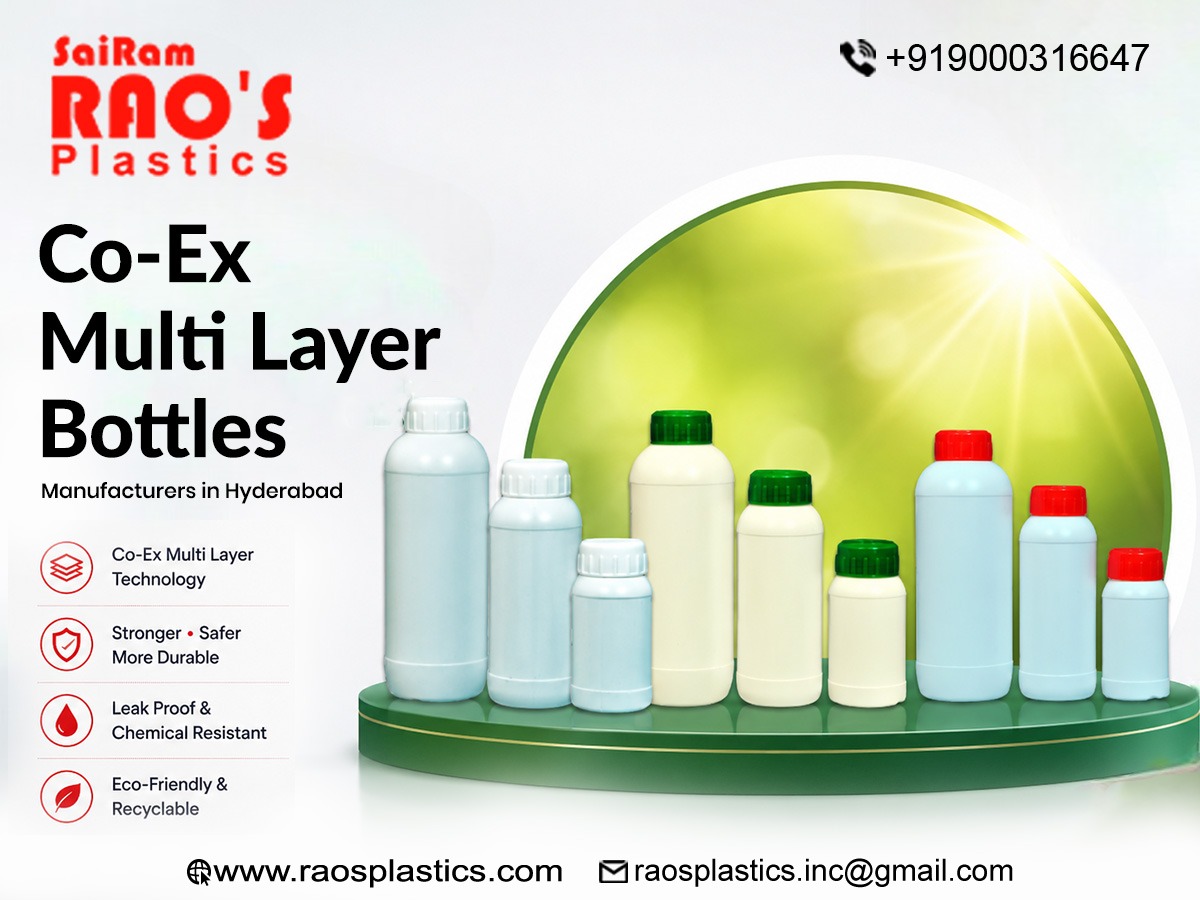
Rao’s Plastics provides co-extruded plastic bottle solutions for businesses looking for practical packaging options for pesticide and agricultural formulations. Co-extrusion technology makes it possible to combine multiple material layers within one bottle structure, allowing packaging manufacturers to develop containers with application-focused characteristics. Depending on the formulation and packaging requirements, different layers can contribute to properties such as structural strength, barrier performance, chemical compatibility, and overall bottle integrity.
Co Ex pesticide bottles are plastic containers manufactured using a co-extrusion process. In simple terms, co-extrusion involves combining multiple layers of compatible materials during the manufacturing process to create a single bottle with a multilayer structure.
Each layer can be selected or designed to contribute a particular function. One layer may provide structural support, another may help improve barrier characteristics, while another may be selected for compatibility with the product being packaged. The exact material combination and layer structure depend on the bottle design, formulation requirements, manufacturing process, and intended application.
This makes co-extruded packaging different from conventional single-layer containers. Instead of depending on one material to provide every required property, multilayer construction can be developed to balance different packaging characteristics.
For agricultural chemical manufacturers, this can be particularly useful because packaging requirements may vary significantly from one formulation to another. The bottle must be evaluated not only for appearance but also for compatibility, containment, transportation, storage, filling, closure, and handling requirements.
Pesticide products can have specific packaging requirements based on their chemical composition and intended use. The packaging must be suitable for the formulation and capable of maintaining product containment during normal storage and transportation.
A properly designed co-extruded bottle can provide a combination of structural and functional characteristics. Multilayer construction can support the development of bottles that are designed around particular product requirements instead of relying on a generic container.
The objective is to create a container that works effectively with the product and the overall packaging process.
Multi Layer Pesticide Bottles Manufacturers in Hyderabad focus on packaging solutions in which multiple layers are incorporated into the bottle structure. The use of multiple layers allows manufacturers to consider different performance requirements within a single container.
The number of layers can vary depending on the packaging design and manufacturing technology. Some applications may require specific multilayer structures based on the formulation, while others may prioritize mechanical strength, appearance, or barrier requirements.
Multilayer packaging is therefore not simply about adding more layers. The important consideration is selecting an appropriate structure for the intended application.
A four-layer bottle is one example of multilayer packaging technology that can be developed for specific applications. 4 Layer Bottles Manufacturers in Hyderabad can provide packaging structures designed around the functional requirements of the product and manufacturing process.
A four-layer construction may allow different layers to contribute different characteristics to the bottle. However, the actual function of each layer depends on the materials selected, the manufacturing process, and the product application.
For pesticide and agricultural formulations, the bottle structure should be evaluated for suitability with the formulation and intended storage conditions. Businesses should consider technical specifications and application requirements rather than selecting packaging based solely on the number of layers.
When businesses search for 4 Layer Pesticide Bottles Manufacturers in Hyderabad, they are often looking for packaging that can provide a combination of durability, containment, and application-specific performance.
Four-layer packaging can be considered for agricultural chemical products where multilayer construction is appropriate. The design may be developed according to product requirements, bottle capacity, filling system, closure type, transportation conditions, and storage expectations.
A suitable bottle should maintain its structural integrity during routine handling and should be compatible with the product it contains. Testing and validation are important steps in determining whether a specific bottle construction is appropriate for a particular pesticide formulation.
Co-extruded multilayer bottles can provide several potential benefits when properly designed for their intended application.
The primary advantage of co-extrusion is the ability to combine different materials or material characteristics within one bottle structure. This can help manufacturers develop packaging around specific performance requirements.
A properly designed multilayer structure can provide the required mechanical characteristics for handling, transportation, and storage. Bottle strength depends on the complete design, material selection, wall thickness, manufacturing process, and application.
Agricultural chemical packaging needs dependable containment. A suitable bottle and closure system can help minimize leakage risks during normal handling and transportation when properly designed and tested.
Different pesticide formulations may require different packaging considerations. Co-extrusion offers flexibility in designing multilayer structures based on the intended application.
Bottle shape, grip, weight, capacity, and closure design can influence the user experience. A well-designed pesticide bottle can support convenient handling during storage and application.
Packaging is also an important part of product identification. Bottle shape, surface finish, labeling area, and overall design can contribute to a professional product presentation while supporting brand recognition.
Co-extruded pesticide bottles can be considered for different agricultural chemical packaging applications, subject to formulation compatibility and applicable packaging requirements.
Potential applications include packaging for:
The exact suitability of a bottle depends on the formulation and required packaging specifications. Manufacturers should conduct appropriate compatibility and performance evaluations before selecting a final container.
Selecting the right pesticide bottle requires more than choosing a specific size or appearance. Several technical and commercial factors should be evaluated.
The first consideration is whether the bottle material and construction are suitable for the formulation. Chemical compatibility should be evaluated under relevant storage and handling conditions.
Different agricultural products require different packaging volumes. Bottle capacity should match the product quantity, filling process, transportation requirements, and user needs.
Bottle geometry can affect filling, stacking, labeling, handling, and storage. The shape should be selected according to both manufacturing and end-user requirements.
The neck finish and closure must work together to provide appropriate sealing and user convenience. Closure compatibility is an important part of the overall packaging system.
For multilayer bottles, the layer structure should be selected based on the functional requirements of the application. The objective is to achieve the required balance between performance, manufacturing feasibility, and cost.
The bottle should be evaluated for the conditions it may experience during transportation and storage. Temperature, handling, stacking, and distribution conditions can influence packaging requirements.
Agriculture continues to depend on effective crop protection products, and packaging remains an important part of the supply chain. From the manufacturing facility to distributors, retailers, agricultural professionals, and end users, pesticide bottles may pass through multiple handling stages.
A well-designed container needs to remain suitable throughout these stages. This is where multilayer packaging technology can offer an application-focused approach. Instead of treating the bottle as a simple container, manufacturers can consider the complete product journey and develop packaging around practical requirements.
For businesses, this can mean looking beyond basic bottle appearance and evaluating factors such as material construction, compatibility, strength, closure performance, labeling, handling, and storage.
Rao’s Plastics provides packaging solutions for businesses seeking Co Ex Pesticide Bottles Manufacturers in Hyderabad. The company focuses on plastic bottle requirements for agricultural and chemical packaging applications, with attention to product specifications and practical manufacturing needs.
Businesses may require different bottle capacities, designs, layer structures, and configurations depending on their products. A suitable packaging solution should therefore be developed around the intended application rather than using the same bottle design for every product.
Rao’s Plastics can be considered by manufacturers looking for multilayer bottle solutions where construction, containment, durability, and packaging functionality are important considerations.
The demand for Co Ex Multi Layer Bottles Manufacturers in Hyderabad is connected to the broader requirement for specialized plastic packaging. Multilayer technology can be used when manufacturers require a combination of characteristics that may be difficult to achieve through a single material layer.
The design of the bottle can be considered according to the product, manufacturing system, filling process, storage conditions, and distribution requirements. This makes co-extruded bottles a useful option for businesses that require more application-focused packaging.
For pesticide packaging, the focus should remain on selecting an appropriate material structure and validating the bottle for its intended use.
Quality is essential in agricultural chemical packaging. A bottle should be manufactured with consistency in dimensions, weight, wall structure, neck finish, appearance, and overall construction.
Quality checks can help identify manufacturing variations and ensure that bottles meet the required specifications. Depending on the application, businesses may also consider leak testing, dimensional inspection, material verification, closure compatibility, and product-container compatibility testing.
The appropriate testing program depends on the product, packaging design, applicable requirements, and intended market.
Modern packaging discussions increasingly include material efficiency and responsible plastic use. While pesticide packaging must satisfy strict functional requirements, manufacturers can also consider material optimization, appropriate bottle weight, production efficiency, and responsible handling of plastic packaging.
The objective should be to balance performance and material use without compromising the packaging requirements of the agricultural formulation. Any sustainability approach should be evaluated alongside product compatibility, safety, durability, and regulatory requirements.
Agricultural packaging is evolving alongside changes in farming practices, product formulations, manufacturing technologies, and supply-chain expectations. As packaging requirements become more specialized, multilayer technologies can provide manufacturers with additional options for developing application-focused containers.
The future of pesticide packaging is likely to involve greater attention to material efficiency, improved container design, consistent manufacturing, compatibility, user convenience, and responsible packaging practices.
Co-extrusion can support this development by allowing manufacturers to combine different functional characteristics into a single packaging structure. However, the right solution will always depend on the specific formulation and application.
Co Ex pesticide bottles are multilayer plastic containers manufactured using co-extrusion technology. Multiple layers are combined to create a bottle structure designed around specific packaging requirements.
Multilayer construction can allow different layers to contribute different functional characteristics, such as structural performance, barrier properties, and material compatibility, depending on the selected materials and bottle design.
Four-layer bottles may be suitable for certain pesticide formulations, but suitability depends on the product formulation, material compatibility, bottle construction, storage conditions, and applicable packaging requirements.
Consider manufacturing capabilities, multilayer technology, material options, bottle specifications, customization, quality controls, production consistency, and the manufacturer's ability to address your particular packaging requirements.
The bottle material must be suitable for the formulation it contains. Compatibility evaluation helps determine whether the container can maintain its intended performance during storage and handling.